
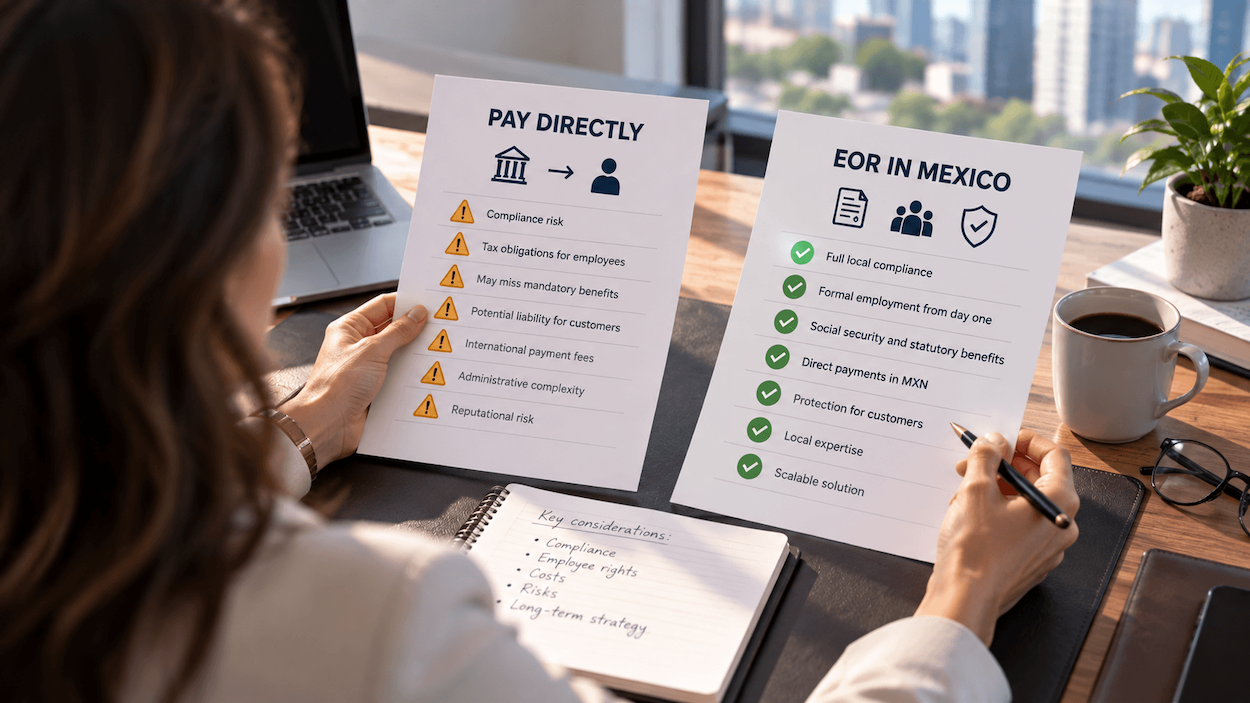
Sure, you could skip the EOR and pay your employees in Mexico directly, but…
For many foreign companies, hiring talent in Mexico raises a seemingly straightforward question: Why establish a local entity or hire an Employer of Record when you can simply pay someone directly?
The arrangement sounds convenient. A Mexican worker performs the work, the foreign company transfers the agreed compensation, and everyone moves on. No local payroll. No employment administration. No EOR fees.
But there’s an important distinction between paying someone for their services and legally employing them in Mexico. And overlooking that difference can create unexpected risks for the company, the worker, and even the company’s customers.
First, How Can You Tell If an Employment Relationship Exists?
Under Mexico’s Federal Labor Law, an employment relationship exists when an individual provides personal services under another party’s direction and control in exchange for compensation. The key concept is subordination.
Even without a signed employment contract, an employment relationship may exist if the actual working conditions demonstrate that the individual operates as an employee.
Some common indicators include:
- Reporting directly to a manager or supervisor.
- Receiving regular, recurring payments.
- Performing ongoing activities that are part of the company’s operations.
- Using company-provided equipment, tools, or systems.
- Having attendance or working hours monitored.
- Working exclusively for one company.
Not every indicator must be present, and none automatically determines employment status. What matters most is whether the company exercises authority over how the individual performs their work.
What Employee Rights Could Be Compromised?
When an actual employment relationship exists, employees are entitled to the protections and benefits established by Mexican law, regardless of where their employer is located.
Without a properly structured employment arrangement, workers may miss out on:
- Social Security
- Retirement Savings
- INFONAVIT
- Year-End Bonus
- Paid Vacation
- Vacation Premium
- Seniority and Employment Protection
Even if a foreign company is willing to provide all mandatory benefits, it may not be able to fully comply with Mexican employment requirements without a registered employer structure in the country.
In particular, registering employees with the Mexican Social Security Institute (IMSS) and making the required contributions to INFONAVIT and the Retirement Savings System (SAR) require the appropriate local employer registration.
While certain benefits can be paid directly to employees, mandatory social security, housing, and retirement contributions cannot simply be replaced with additional compensation.
The absence of a formal employment contract does not eliminate these rights. If the relationship meets the legal criteria for employment, the corresponding obligations may still apply, regardless of what the parties have agreed to call it.
The Tax Obligations Many Workers Overlook
Receiving payments from a foreign company does not exempt workers from Mexican taxes. When a Mexican tax resident receives employment income from a foreign employer that does not withhold Mexican income tax (ISR), the employee is generally responsible for calculating and paying it.
Many workers are unaware of this or treat the entire amount as disposable income. Over time, this can lead to significant unpaid taxes, interest, inflation adjustments, and penalties.
The Hidden Costs of International Payments
International bank transfers and certain payment platforms charge fees for receiving, converting, or withdrawing funds. In some cases, these costs are passed directly to the worker, reducing the amount they actually receive.
As a result, a seemingly straightforward international transfer does not necessarily guarantee that the worker receives the full compensation originally agreed upon.
Under Mexico’s Federal Labor Law, employers are responsible for covering the costs associated with electronic salary payments. Employees should not have to absorb these expenses. However, this legal requirement is often overlooked, particularly when salaries are paid directly from abroad.
What Risks Does the Foreign Company Face?
Reinstatement of the employee is another option, although it is not one of the most commonly used.A common misconception is that a foreign company without a Mexican legal entity has no exposure to employment-related claims in Mexico.
Mexican labor law does not make the existence of an employment relationship dependent on where the employer is located. Instead, it focuses on the actual conditions under which the work is performed.
While pursuing and enforcing a labor claim against a foreign company with no legal presence in Mexico can be extremely challenging, this does not necessarily prevent a worker from initiating legal proceedings. Even when enforcement is difficult, such proceedings may create an undesirable legal record and potential reputational consequences for the foreign employer.
The exposure may also extend to third parties. When a worker is assigned to provide services at a customer’s facilities in Mexico, the absence of a clearly established and compliant employment arrangement may expose that customer to labor claims and potential joint liability, depending on the circumstances.
When Workers Perform Duties at a Customer’s Facilities
Another situation worth considering is when workers visit a customer’s facilities. For example, a foreign machinery manufacturer may pay an engineer based in Mexico directly from abroad and send them to a local customer’s site for installation or technical support.
If the engineer is not registered with IMSS, a workplace accident could create legal and administrative complications for the Mexican customer. Regardless of who employs the engineer, having someone perform work on-site without the corresponding social security coverage may expose the company operating the facility to investigations and potential liabilities.
This is why many industrial facilities require external personnel to provide proof of formal employment and active IMSS coverage before granting access.
Reputation
Employer reputation matters too. Today, employees share their experiences through professional networks, employer review platforms, and online communities. A company that later expands in Mexico may find that its employment history becomes either an advantage or an obstacle in attracting talent.
For many international companies, compliance is more than a legal requirement. It is part of their corporate culture, internal policies, and commitment to corporate integrity and ethical business practices.
Whether motivated by legal risk management, reputation protection, corporate standards, or simply a genuine desire to do the right thing, these companies recognize the importance of respecting employee rights and complying with local laws.
Ultimately, the question is not just whether a company can pay someone directly from abroad, but whether that arrangement aligns with its values, principles, and commitment to responsible business practices.
So, Is It Illegal to Hire Workers in Mexico Directly?
Not necessarily. Foreign companies can hire workers in Mexico and pay them directly from abroad. However, this arrangement alone does not provide the structure needed to comply with all mandatory employment obligations, particularly social security, housing, and retirement contributions.
For many international companies, compliance is more than a legal requirement. It is part of their corporate culture, internal policies, and commitment to corporate integrity and ethical business practices.
Whether motivated by legal risk management, reputation protection, corporate standards, or simply a genuine desire to do the right thing, these companies recognize the importance of respecting employee rights and complying with local laws.
Ultimately, the question is not just whether a company can pay someone directly from abroad, but whether that arrangement aligns with its values, principles, and commitment to responsible business practices.
Why Does Working With an EOR in Mexico Make Sense?
An Employer of Record is a company established in Mexico that, through a contractual and operational structure compliant with applicable regulations, acts as the formal employer and manages the corresponding labor, tax, and social security obligations. The foreign company focuses on its business and team performance, while the EOR handles local employment administration.
Key advantages include:
- Formal employment from day one: Mexican employment contracts and legally mandated rights and benefits.
- Accurate payroll: Calculation of salaries, taxes, social security contributions, and withholdings, with official electronic payroll receipts (CFDI).
- Social security and statutory benefits: IMSS registration, plus employer contributions to INFONAVIT and retirement savings.
- Direct payments in Mexican pesos: Salaries deposited directly into local bank accounts, without requiring employees to pay international platform fees or currency conversion charges.
- Protection for customers and business partners: Proper employment documentation and social security coverage help reduce the risk of labor claims, workplace accident liabilities, and compliance issues affecting third parties.
- Local expertise: Support in managing employment obligations, maintaining compliance, and anticipating potential issues.
- Room to grow: The ability to start with one or several employees without immediately incorporating
Those costs don’t disappear because payments come from abroad. An EOR charges a fee for managing them, but it also provides an established local infrastructure without the need to create and maintain a separate legal entity.
At Umanium, we help international companies hire and manage employees in Mexico, combining local expertise, personalized service, and extensive knowledge of Mexican labor, tax, and social security regulations. Our goal is to let companies focus on growing their businesses while having the local support they need to operate in Mexico responsibly.
Because paying someone in Mexico can be very simple. What really matters is making sure the employment relationship behind that payment is properly structured.
Disclaimer: This article is intended for general informational purposes only and does not constitute legal or tax advice. Applicable obligations depend on the nature of each contractual relationship and the specific circumstances of the parties involved.